Dropshipping in secondary employment: reality vs promises
Dropshipping is often presented as the ideal way to start a webshop in a secondary occupation. No stock, no warehouse, no big investments and everything completely online. For people with permanent jobs, home workers or entrepreneurs looking for extra income, this sounds like a low-threshold way to start e-commerce. The barrier to entry seems small and the promise of flexibility is great.
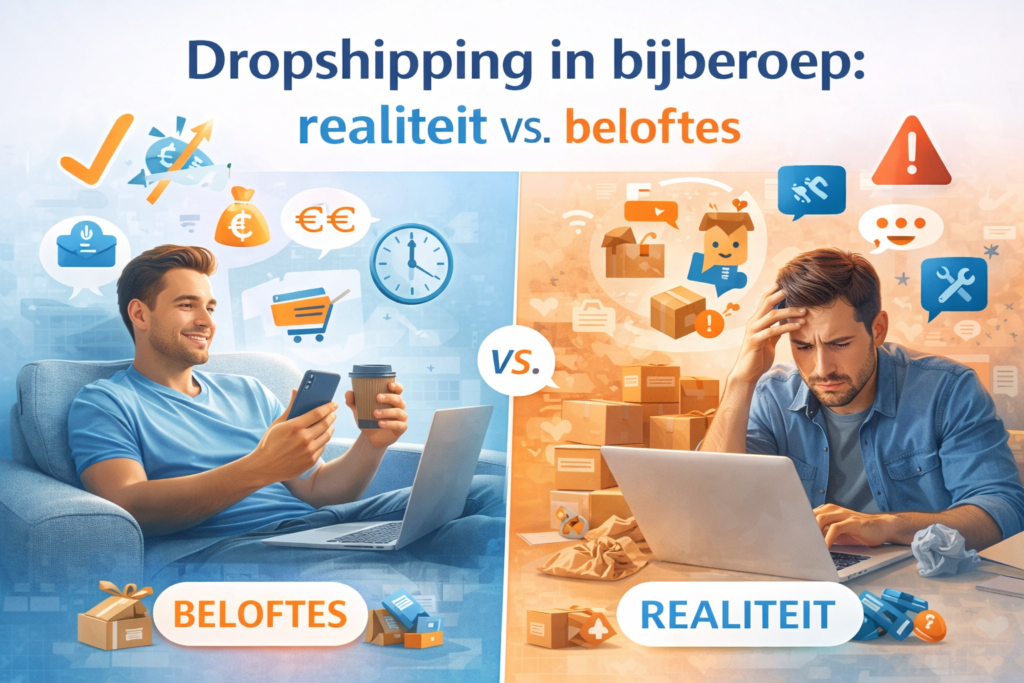
Yet after a few weeks or months, many start-ups find that dropshipping in secondary employment much more demanding than expected. What is often presented online as simple and largely automatic, in practice turns out to be a full-fledged webshop with daily follow-up, customer service and technical responsibilities. In this blog, we explain the difference between what is often promised and what the reality is once your webshop is effectively running.
What exactly is dropshipping?
Dropshipping is an e-commerce model where you sell products without keeping stock yourself. When a customer places an order in your webshop, that order is forwarded to an external supplier, who ships the product directly to the customer. You act as an intermediary between the customer and the supplier, but for the customer you are the only point of contact.
What is often misunderstood is that as a webshop owner, you remains fully responsible for the order. The customer has no relationship with the supplier and expects correct delivery, communication and service from you. Problems with shipping, damaged products or wrong deliveries therefore always come to you.
You are also responsible for payments, returns, refunds and complaint handling. Even when the fault lies with the supplier, the customer expects a solution from your shop. This makes dropshipping as a part-time job a lot more intensive than many starters anticipate. Especially when combined with a permanent job, it requires good organisation and follow-up.
Keywords: dropshipping explanation, what is dropshipping, start dropshipping webshop
The promises around dropshipping in secondary employment
Online, dropshipping is often presented as a low-threshold way to make money quickly. Videos, advertisements and courses especially emphasise how easy it would be to set up a webshop without large investments. For people who have extra time in the evenings or weekends, this sounds particularly attractive.
A common promise is that you do not need stock, which would reduce risk. In addition, it is often said that dropshipping is perfect to combine with a permanent job, as everything would largely run automatically. The idea that you need little technical knowledge and that your webshop can scale quickly is also often repeated.
What is usually missing from these promises is the reality once your webshop is effectively live. The focus is very much on the start-up phase, but hardly on day-to-day management. As soon as the first orders arrive, it becomes clear that automation is only part of the story. Customers expect follow-up, answers and solutions, regardless of whether your webshop is a side business. The promises sound attractive, but rarely take into account the structural tasks that keep coming back.
The reality: dropshipping is not passive income
Contrary to popular belief, dropshipping is not a passive source of income. Even when your webshop is technically sound, daily tasks keep cropping up. Orders need to be checked, customers need to be informed and problems need to be solved as soon as they arise.
For people doing dropshipping in a secondary occupation, this usually happens outside working hours. Evenings and weekends are filled with follow-ups, which can weigh heavily over time. Small problems often take more time than expected, especially if you don't have a technical background.
In addition, the situation is constantly changing. Suppliers change prices, products go out of stock or are no longer supplied. As a result, you have to regularly update and check product information. This makes dropshipping anything but automatic. Without a clear structure or support, it can quickly lead to frustration and lack of time.
Keywords: dropshipping side job, dropshipping alongside permanent job
Customer service in dropshipping: the biggest stumbling block
Customer service is one of the biggest challenges in dropshipping webshops. Because you have no control over shipping and production, problems arise more quickly. Customers always turn to your webshop for questions or complaints, not to the supplier.
Common situations include delayed deliveries, wrongly delivered products or customers who become impatient because they have not yet received their order. When these queries are not followed up quickly and professionally, dissatisfaction ensues. This often leads to negative reviews, chargebacks or even complaints to payment providers.
For people who combine dropshipping with a permanent job, this is particularly difficult. You cannot always respond immediately, while customers expect you to. That is why more and more dropshippers choose to outsource customer service, so that questions and problems are followed up in a timely manner and the webshop continues to appear professional.
Keywords: customer service dropshipping, customer service webshop outsourcing
Returns and refunds: underestimated but crucial
Returns and refunds are an important but often underestimated part of dropshipping. Customers expect a clear return policy and smooth handling when something is not right. In dropshipping, however, this is more complex because you rely on external suppliers.
Not every supplier accepts returns, or charges high fees. This means that you as a webshop owner often have to intervene, both financially and communicatively. Handling refunds correctly requires administration, follow-up and clear communication with the customer.
When not handled properly, it leads to customer frustration and extra work for you. For entrepreneurs in a secondary occupation, this can quickly become too heavy, especially when multiple return requests come in at the same time.
Technical complexity of dropshipping webshops
Dropshipping webshops are often technically more complex than classic webshops. They use product import tools, stock links and automatic price updates. This makes them more susceptible to errors and compatibility problems.
After updates, problems such as incorrect product information, disappeared products or non-working payment modules regularly arise. For someone in secondary employment, this is difficult, as technical problems often need to be solved immediately to avoid loss of sales.
Many entrepreneurs solve this by opting for technical maintenance or a webshop maintenance package, so updates, backups and troubleshooting don't lag.
Keywords: dropshipping webshop maintenance, technical webshop maintenance
Marketing and advertising: no guarantee of success
Another misconception is that products sell themselves once ads run. In reality, marketing requires constant follow-up. Ads need to be optimised, product pages adjusted and conversions analysed.
Without follow-up, advertising budgets can quickly be lost without results. This requires time, knowledge and analysis, which is often difficult for sideline entrepreneurs to combine with other commitments.
Combining dropshipping with a permanent job
Combining dropshipping with a permanent job is possible, but requires realism. Many start-ups quit because they underestimate the workload. Customer service, technical problems and administration keep piling up alongside their main job.
By outsourcing tasks such as webshop management, customer service or technical maintenance, dropshipping remains more manageable. This allows you to focus on marketing and growth, without constantly having to put out fires.
Keywords: dropshipping combine with permanent job, dropshipping side income
When does dropshipping in secondary employment work?
Dropshipping in secondary employment can work if you approach it as a real business. That means you provide time for follow-up, are willing to hire support and understand that automation has limits.
Those who invest in structure, support and customer service significantly increase the chances of success. It is not a quick money model, but a long-term project.
Conclusion: dropshipping requires more than is often promised
Dropshipping in a side business is not a simple side income without worries. It is a full-fledged webshop with customers, technical obligations and daily follow-up. Those who realise this and enlist support where needed can successfully combine dropshipping with a regular job.